Clinical Hours: Mon-Fri, 8AM - 3PM(905) 493-5700
1885 Glenanna Road, Suite 220, Pickering, ON, L1V 6R6
A dermatologist weighs whether a suntan is healthy or harmful, balancing skin cancer and photoaging risks against the controlled medical use of ultraviolet light.

A bronzed glow is still widely treated as a marker of health and vitality, yet the science tells a more complicated story. The same ultraviolet radiation that darkens the skin is also the most common preventable cause of skin cancer, and, at the same time, it is harnessed under careful medical control to treat several stubborn skin diseases. So is a suntan good or bad? The honest dermatological answer is that unprotected tanning is harmful, while ultraviolet light used as a prescribed, monitored treatment can be genuinely beneficial. Understanding that distinction is the key to the whole debate.
A tan is not a sign of health. It is the visible result of injury. When ultraviolet radiation penetrates the skin, it damages the DNA inside skin cells. In response, pigment-producing cells called melanocytes manufacture additional melanin and transfer it to surrounding cells, where it forms a protective shield over the cell nucleus. This darkening, the tan itself, is the skin's emergency attempt to limit further genetic damage [1].
Because tanning is a response to DNA damage, there is no such thing as a safe tan from the sun or from a tanning bed. Any visible change in colour reflects damage that has already occurred. The World Health Organization's International Agency for Research on Cancer classifies the full spectrum of solar ultraviolet radiation, and the ultraviolet-emitting tanning devices that mimic it, as Group 1 carcinogens, the same category as tobacco and asbestos [2].
Ultraviolet exposure is the principal external cause of premature skin aging and, more importantly, a primary cause of skin cancer [2]. The damage is cumulative. Every unprotected exposure adds to a lifetime burden that the skin records faithfully, often surfacing as cancer years or decades later.
The most visible early marker of cumulative sun damage is the actinic keratosis, a rough, scaly patch that develops on chronically exposed skin such as the face, scalp, ears, and the backs of the hands. Actinic keratoses are considered precancerous. A classic longitudinal study followed these lesions over time and estimated the rate at which an individual lesion progresses to invasive cancer, confirming that they sit on a continuum that can end in squamous cell carcinoma [3].
Two main forms of non-melanoma skin cancer follow from this chronic damage. Basal cell carcinoma is the most common skin cancer; it grows slowly and rarely spreads, but it can be locally destructive if it is neglected. Squamous cell carcinoma is less common, yet it carries a greater capacity to invade surrounding tissue and, in a minority of cases, to spread to other sites. Both are strongly associated with cumulative ultraviolet exposure [2].
When a suspicious lesion is found, a small sample of tissue is taken during a skin biopsy and examined under the microscope to confirm the diagnosis. Treatment of widespread sun damage may also involve photodynamic therapy, in which a light-sensitizing agent is applied to the skin and then activated by a specific wavelength of light to clear actinic keratoses and certain superficial skin cancers across a sun-damaged area.
Melanoma is the most dangerous form of skin cancer because of its ability to spread to distant organs. Its relationship with ultraviolet light is more complex than that of the non-melanoma cancers, but intense, intermittent exposure and a history of sunburn, particularly in childhood, are recognized risk factors. Intentional tanning is therefore not a harmless cosmetic choice.
Tanning beds deserve particular caution. A systematic review and meta-analysis found that sunbed use is associated with a significantly increased risk of melanoma, and that the risk is greater when use begins before the age of 35 [4]. Largely because of evidence of this kind, many jurisdictions, including Canadian provinces, now restrict the use of commercial tanning beds by minors.
Regular monitoring matters. A periodic skin cancer screening allows moles and other lesions to be examined and, where appropriate, mapped over time, so that early changes are identified while treatment remains simple.
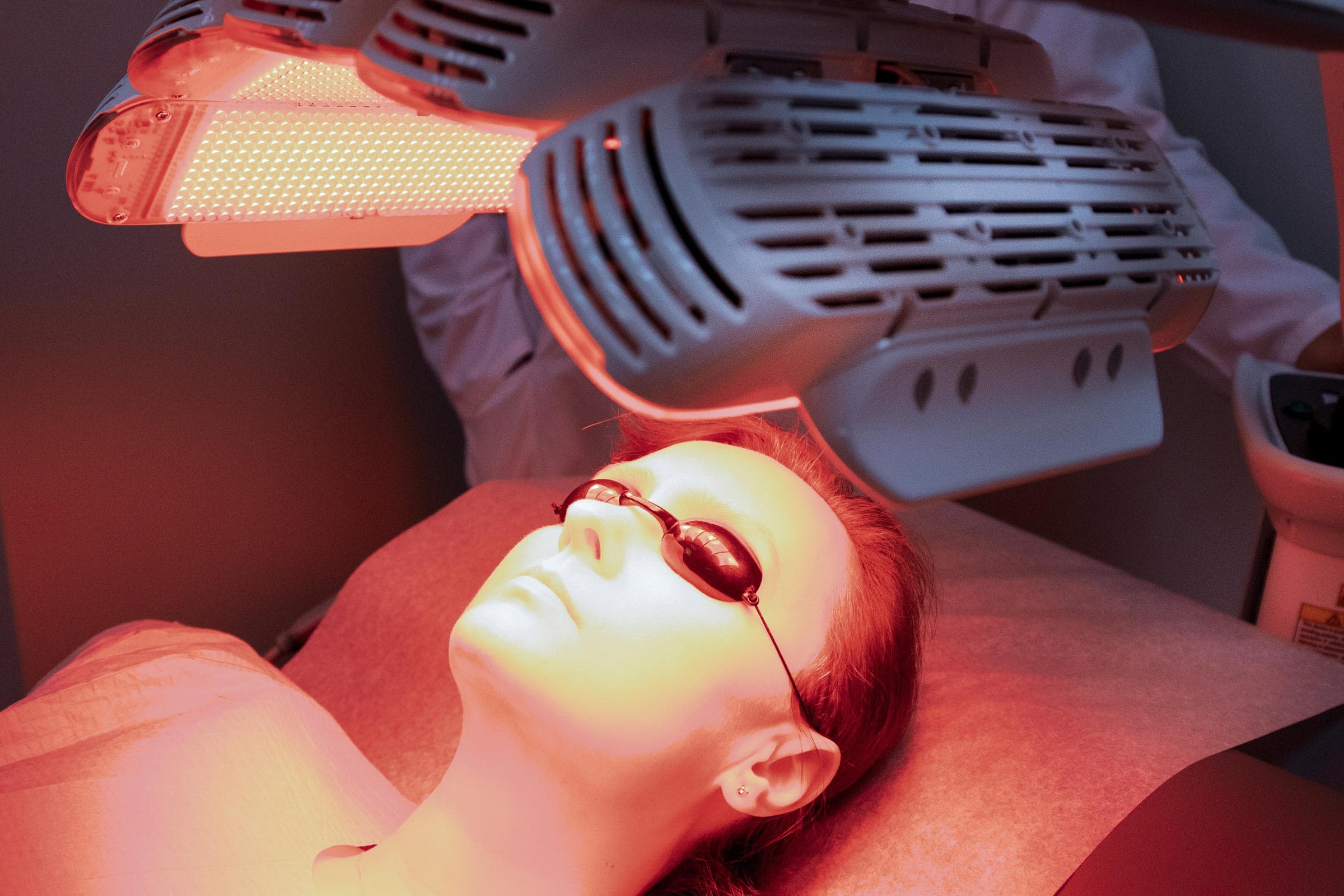
If ultraviolet light is so damaging, why is it used deliberately in the clinic? The answer lies in dose, precision, and indication. The same properties that make ultraviolet light hazardous in uncontrolled amounts, namely its ability to slow cell proliferation and to modulate the local immune response, can be turned to therapeutic advantage when the wavelength, dose, and treatment site are tightly controlled. This practice is called phototherapy, and it is delivered most often as narrowband UVB phototherapy, a narrow band of ultraviolet B centred near 311 nanometres.
Psoriasis responds well to controlled ultraviolet light, which slows the excessive turnover of skin cells and calms the underlying inflammation. Narrowband UVB is a well-established, guideline-supported treatment for moderate plaque psoriasis, valued for its effectiveness and its long record of safety when it is properly dosed [5].
Eczema, or atopic dermatitis, can also improve with phototherapy when topical treatment alone is insufficient. An updated systematic review of photo- and photochemotherapy concluded that ultraviolet treatment, and narrowband UVB in particular, can reduce the signs and symptoms of atopic dermatitis, supporting its place as a second-line option [6].
In vitiligo, where patches of skin lose their colour because pigment cells are destroyed, ultraviolet light is used for the opposite of a tan: to encourage repigmentation. Narrowband UVB stimulates surviving melanocytes, including those within hair follicles, to migrate and restore colour to the affected skin. A systematic review and meta-analysis reported meaningful repigmentation in a substantial proportion of treated patients, establishing phototherapy as a cornerstone of vitiligo management [7].
The therapeutic use of ultraviolet light is easily confused with sunbathing, but the two are fundamentally different. Phototherapy uses a defined wavelength chosen for a specific biological effect, delivered in a measured dose calculated for the individual, supervised by trained staff, and prescribed only when the expected benefit outweighs the risk. Cumulative exposure is recorded, uninvolved skin is shielded, and treatment is stopped once the clinical goal is reached.
A suntan, by contrast, is uncontrolled, unmeasured, and pursued for appearance rather than for a medical indication. It delivers a broad and poorly defined dose of radiation to skin that gains no therapeutic benefit, only accumulated damage. The existence of medical phototherapy is therefore not an argument in favour of recreational tanning; it is an illustration of how a known hazard can be carefully harnessed for a defined clinical purpose.
Supported: Ultraviolet light has genuine, evidence-based medical uses, and controlled phototherapy can substantially improve psoriasis, eczema, and vitiligo.
Overstated: The belief that a suntan is healthy, that a base tan protects the skin, or that recreational tanning offers anything like the benefit of medical phototherapy. A tan is visible evidence of DNA damage, not a sign of health.
Vitamin D is often raised as a reason to seek the sun. Ultraviolet B does drive vitamin D synthesis in the skin [1], but the exposure required to maintain healthy levels is small, and the requirement can be met safely through diet and supplements without the cancer risk that accompanies deliberate tanning. For everyday skin, the most protective habit remains consistent sun protection.
Talk to a dermatologist. If sun-damaged skin is a concern, or if a chronic condition such as psoriasis, eczema, or vitiligo might benefit from supervised light treatment, a consultation can clarify which options are appropriate for your skin.
This article is intended for educational purposes and does not replace professional medical advice. Please consult your dermatologist for personalized recommendations.
Your feedback helps us improve our news and clinical insights
From medical dermatology to surgical procedures, our clinic provides comprehensive care for all skin, hair, and nail conditions.